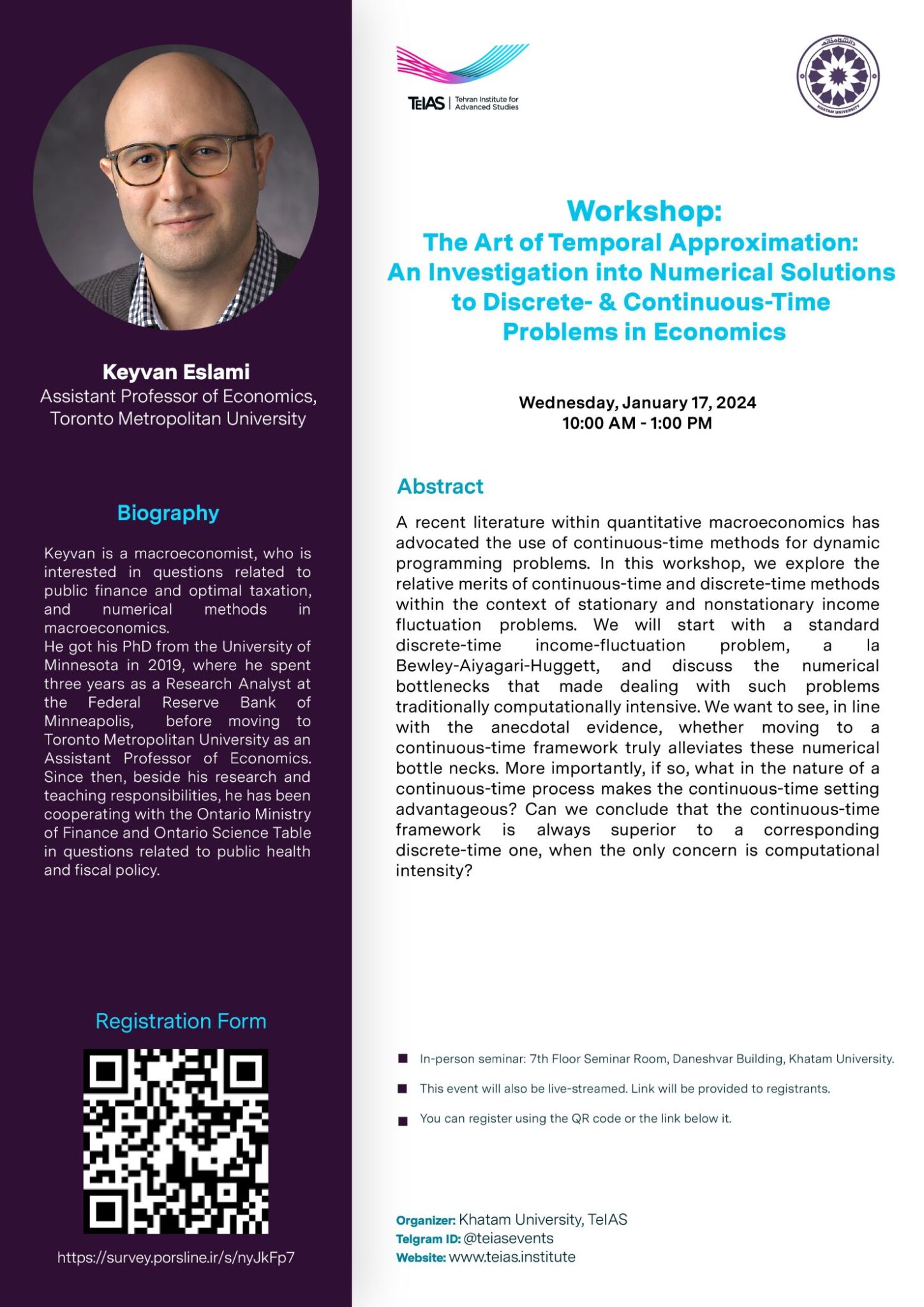
In-person seminar: 7th Floor Seminar Room, Daneshvar Building, .
This event will also be live-streamed. Link will be provided to registrants
January 16, 2024
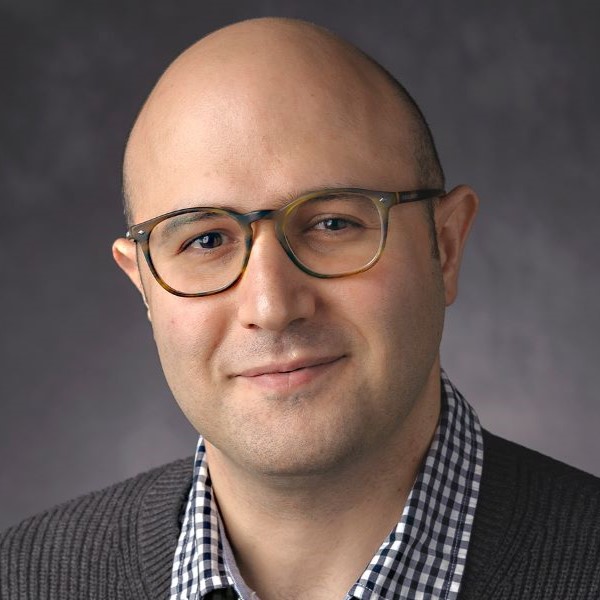
Keyvan Eslami
Assistant Professor of Economics, Toronto Metropolitan University
Overview
A recent literature within quantitative macroeconomics has advocated the use of continuous-time methods for dynamic programming problems. In this workshop, we explore the relative merits of continuous-time and discrete-time methods within the context of stationary and nonstationary income fluctuation problems. We will start with a standard discrete-time income-fluctuation problem, a la Bewley-Aiyagari-Huggett, and discuss the numerical bottlenecks that made dealing with such problems traditionally computationally intensive. We want to see, in line with the anecdotal evidence, whether moving to a continuous-time framework truly alleviates these numerical bottle necks. More importantly, if so, what in the nature of a continuous-time process makes the continuous-time setting advantageous? Can we conclude that the continuous-time framework is always superior to a corresponding discrete-time one, when the only concern is computational intensity?

Biography
Keyvan is a macroeconomist, who is interested in questions related to public finance and optimal taxation, and numerical methods in macroeconomics. He got his PhD from the University of Minnesota in 2019, where he spent three years as a Research Analyst at the Federal Reserve Bank of Minneapolis, before moving to Toronto Metropolitan University as an Assistant Professor of Economics. Since then, beside his research and teaching responsibilities, he has been cooperating with the Ontario Ministry of Finance and Ontario Science Table in questions related to public health and fiscal policy.
Please note that the site is under maintenance. Therefore, some parts of it may not work properly.
During this time, you can connect with us on social media.